
Engineered TdT enzymes for workflows where standard TdTs fall short
Screen six differentiated TdT variants to identify the right fit for modified nucleotides, blocked nucleotides, and demanding synthesis workflows.
6 engineered TdT variants
Built for modified and blocked nucleotides workflows
From screening to optimization, if needed

Why teams come to us
Standard TdTs are not always built for advanced workflows. Teams usually come to us when enzyme performance becomes the bottleneck in a high-value workflow.
Modified or blocked nucleotides limit performance:
Some workflows depend on chemistries that standard TdTs were not designed to support efficiently.
Iterative synthesis requires better control:
When performance needs to hold across repeated cycles, baseline activity is not enough.
A catalog enzyme does not fit the application:
If you are building a new assay, synthesis method, or platform, enzyme fit can matter as much as the protocol itself.

Technical guidance is needed early:
For advanced workflows, teams often need more than a reagent. They need a structured way to evaluate fit and discuss results with people who understand the enzyme deeply.

TDT SYNTHESIS PANEL
Smarter than testing just one enzyme
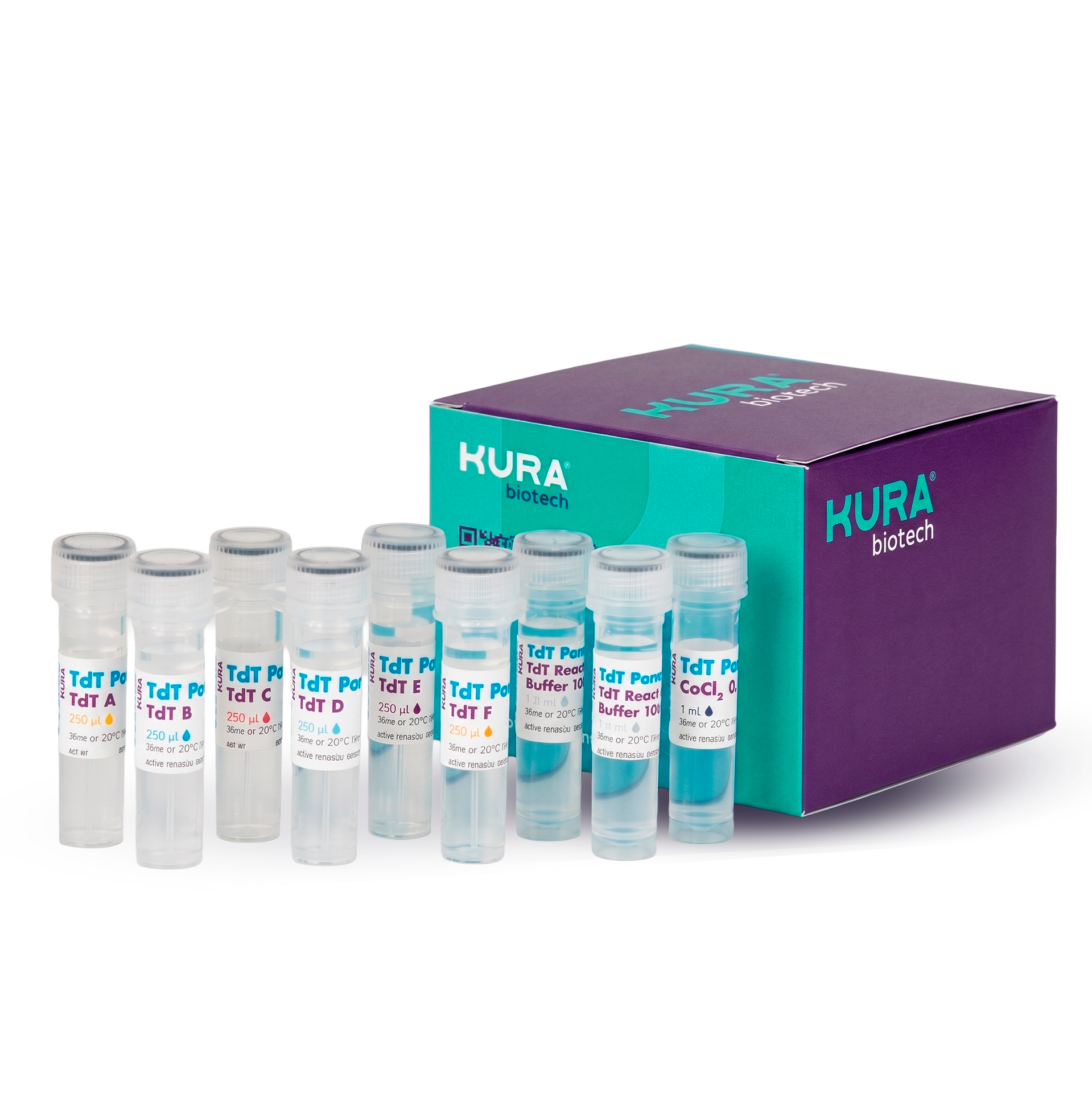
The TdT Synthesis Panel brings together six proprietary, engineered TdT variants with differentiated performance profiles. Instead of relying on a single enzyme and hoping it works in your system, you can screen across multiple TdT backgrounds to identify the strongest starting point for your chemistry and workflow.
Screen differentiated TdT backgrounds
Evaluate fit across natural and modified nucleotide workflows
Reduce technical uncertainty early
Use the best-performing variant as the basis for next steps
Built for demanding synthesis workflows
The panel is designed to help teams evaluate TdT performance under conditions where standard options often fall short.
BLOCKED NUCLEOTIDE STRATEGIES
Selected variants support workflows where controlled nucleotide addition depends on blocked nucleotide compatibility.

MODIFIED NUCLEOTIDE CHEMISTRIES
The panel helps teams evaluate performance beyond natural dNTP-only workflows.

DIFFERENTIATED ENZYME BACKGROUNDS
Not all TdTs behave the same way. Panel diversity improves the chance of finding workflow-specific fit.

A BRIDGE TO OPTIMIZATION
If one variant performs well but not yet well enough, it can serve as the starting point for targeted optimization.
TDT SYNTHESIS PANEL
Smarter than testing just one enzyme
The TdT Synthesis Panel brings together six proprietary, engineered TdT variants with differentiated performance profiles. Instead of relying on a single enzyme and hoping it works in your system, you can screen across multiple TdT backgrounds to identify the strongest starting point for your chemistry and workflow.
Screen differentiated TdT backgrounds
Evaluate fit across natural and modified nucleotide workflows
Reduce technical uncertainty early
Use the best-performing variant as the basis for next steps
Built for demanding synthesis workflows
The panel is designed to help teams evaluate TdT performance under conditions where standard options often fall short.
BLOCKED NUCLEOTIDE STRATEGIES
Selected variants support workflows where controlled nucleotide addition depends on blocked nucleotide compatibility.
MODIFIED NUCLEOTIDE CHEMISTRIES
The panel helps teams evaluate performance beyond natural dNTP-only workflows.
DIFFERENTIATED ENZYME BACKGROUNDS
Not all TdTs behave the same way. Panel diversity improves the chance of finding workflow-specific fit.
A BRIDGE TO OPTIMIZATION
If one variant performs well but not yet well enough, it can serve as the starting point for targeted optimization.
Evidence that helps you make a decision
THE GOAL IS NOT ONE UNIVERSAL WINNER. THE GOAL IS FIT.
The purpose of performance data is not just to show activity. It is to help you assess whether screening across differentiated TdT variants is likely to improve fit for your workflow.
VARIANT DIVERSITY
Different TdT backgrounds behave differently
Screening a panel can be more informative than evaluating a single standard TdT in isolation.
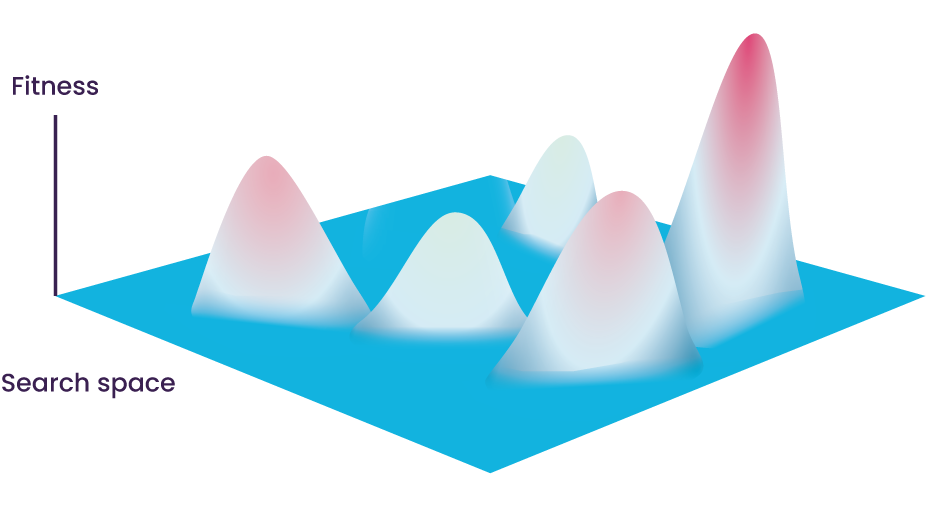
Distinct TdT backgrounds can respond differently across nucleotide classes and synthesis conditions. That diversity is what makes a panel-first approach useful.

6 TdT from different sources Tailored to precisely match your unique requirements, ensuring the best possible fit for you.
MODIFIED PERFORMANCE
Modified nucleotide performance matters
For demanding synthesis workflows, performance with modified chemistry is often the core requirement.
If your workflow depends on non-standard chemistry, modified nucleotide performance is not a secondary feature. It is central to whether the workflow will work.

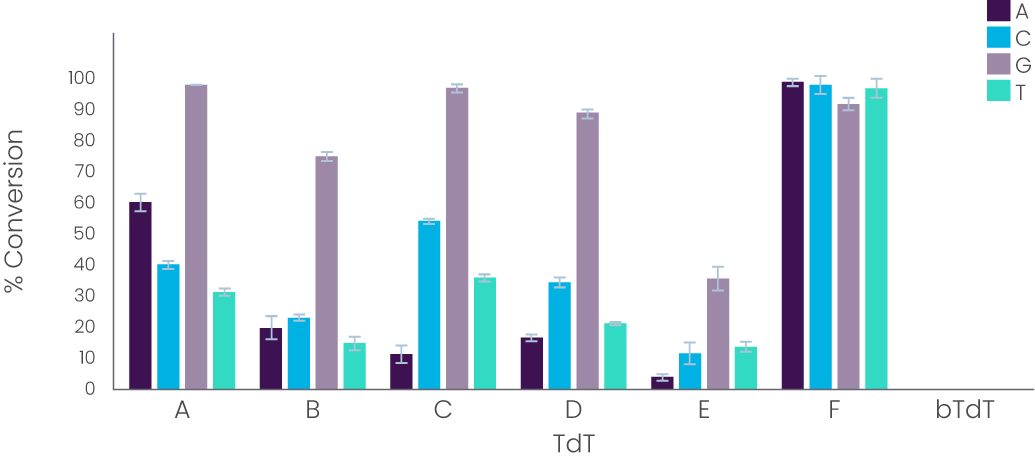
Addition of modified nucleotides. Enzymes were incubated with a 1:10 oligo:dNTP ratio for 30 minutes at 37°C. Bovine TdT didn’t show activity.
WORKFLOW
Evaluate fit across workflow needs
The best TdT is the one that best matches your chemistry and workflow constraints.
The value of screening is not proving that one enzyme wins in every context. It is identifying the strongest candidate for your application.

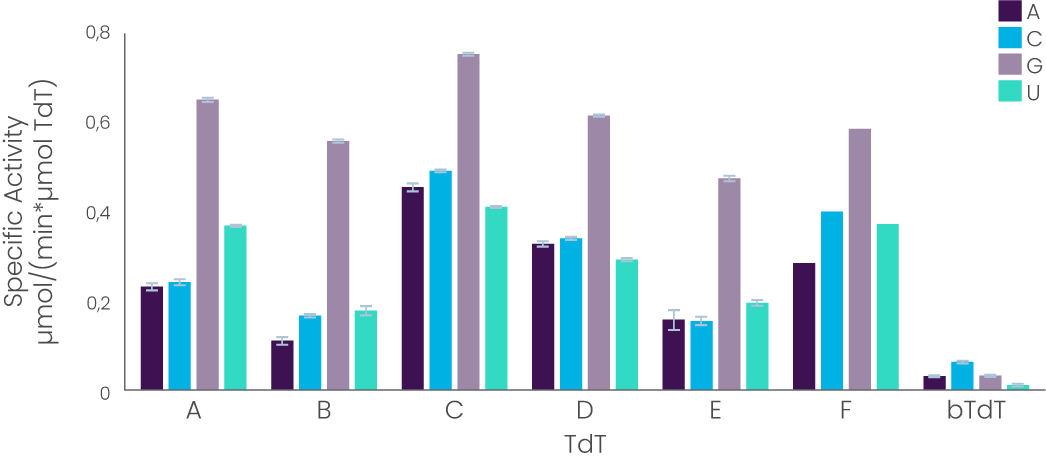
Addition of natural deoxyribonucleotides. Enzymes were incubated with a 1:10 oligo:dNTP ratio for 1 minute at 37°C.
Evidence that helps you make a decision
THE GOAL IS NOT ONE UNIVERSAL WINNER. THE GOAL IS FIT.
VARIANT DIVERSITY
Different TdT backgrounds behave differently
Screening a panel can be more informative than evaluating a single standard TdT in isolation.
Distinct TdT backgrounds can respond differently across nucleotide classes and synthesis conditions. That diversity is what makes a panel-first approach useful.

6 TdT from different sources Tailored to precisely match your unique requirements, ensuring the best possible fit for you.
MODIFIED PERFORMANCE
Modified nucleotide performance matters
For demanding synthesis workflows, performance with modified chemistry is often the core requirement.
If your workflow depends on non-standard chemistry, modified nucleotide performance is not a secondary feature. It is central to whether the workflow will work.

Addition of modified nucleotides. Enzymes were incubated with a 1:10 oligo:dNTP ratio for 30 minutes at 37°C. Bovine TdT didn’t show activity.
WORKFLOW
Evaluate fit across workflow needs
The best TdT is the one that best matches your chemistry and workflow constraints.
The value of screening is not proving that one enzyme wins in every context. It is identifying the strongest candidate for your application.

Addition of natural deoxyribonucleotides. Enzymes were incubated with a 1:10 oligo:dNTP ratio for 1 minute at 37°C.
Looking for the full dataset?
Work directly with the team behind the enzymes
Technical support is part of what makes evaluation useful
Advanced TdT workflows often require discussion around nucleotide compatibility, reaction conditions, screening strategy, and how to interpret early results. We support those conversations directly.
Application fit discussions
Guidance on evaluation strategy
Input on reaction conditions
Follow-up optimization discussions
If one variant stands out
There are several ways to move forward
1. Continue with the selected TdT
For teams that identify a strong fit and want to move directly into continued use.
2. Optimize for your workflow
For teams that need improved performance under specific synthesis constraints, conditions, or nucleotide strategies.
3. Discuss scale or co-development
For teams exploring larger supply needs, deeper technical collaboration, or a more strategic development path.
TECHNICAL FAQ
WHY NOT JUST USE A STANDARD TDT? +
A standard TdT can be suitable for many general workflows. This page is for applications where standard options are not delivering the chemistry, control, or fit required.
HOW DO I KNOW WHICH TDT VARIANT IS RIGHT FOR MY WORKFLOW? +
That is the purpose of the panel. It allows you to evaluate multiple differentiated TdT backgrounds instead of relying on a one-enzyme guess.
DO I NEED TO COMMIT TO CUSTOM DEVELOPMENT FROM THE BEGINNING? +
No. The panel is designed as a practical starting point. Further optimization only makes sense if the evaluation data justifies it.
CAN I DISCUSS MY APPLICATION BEFORE REQUESTING AN EVALUATION? +
Yes. For more complex workflows, a technical discussion may be the most useful first step.
WHAT HAPPENS IF ONE VARIANT PERFORMS WELL? +
You can continue with that TdT, explore workflow-specific optimization, or discuss broader supply and collaboration options.
Ready to identify your right TdT starting point?
Whether you want to test the panel, discuss a specific synthesis challenge, or explore optimization, we can help you choose the right next step.