DeCodiFi™ Long&Complex

High-Fidelity Polymerase for Long-Read Sequencing & Challenging DNA Amplification

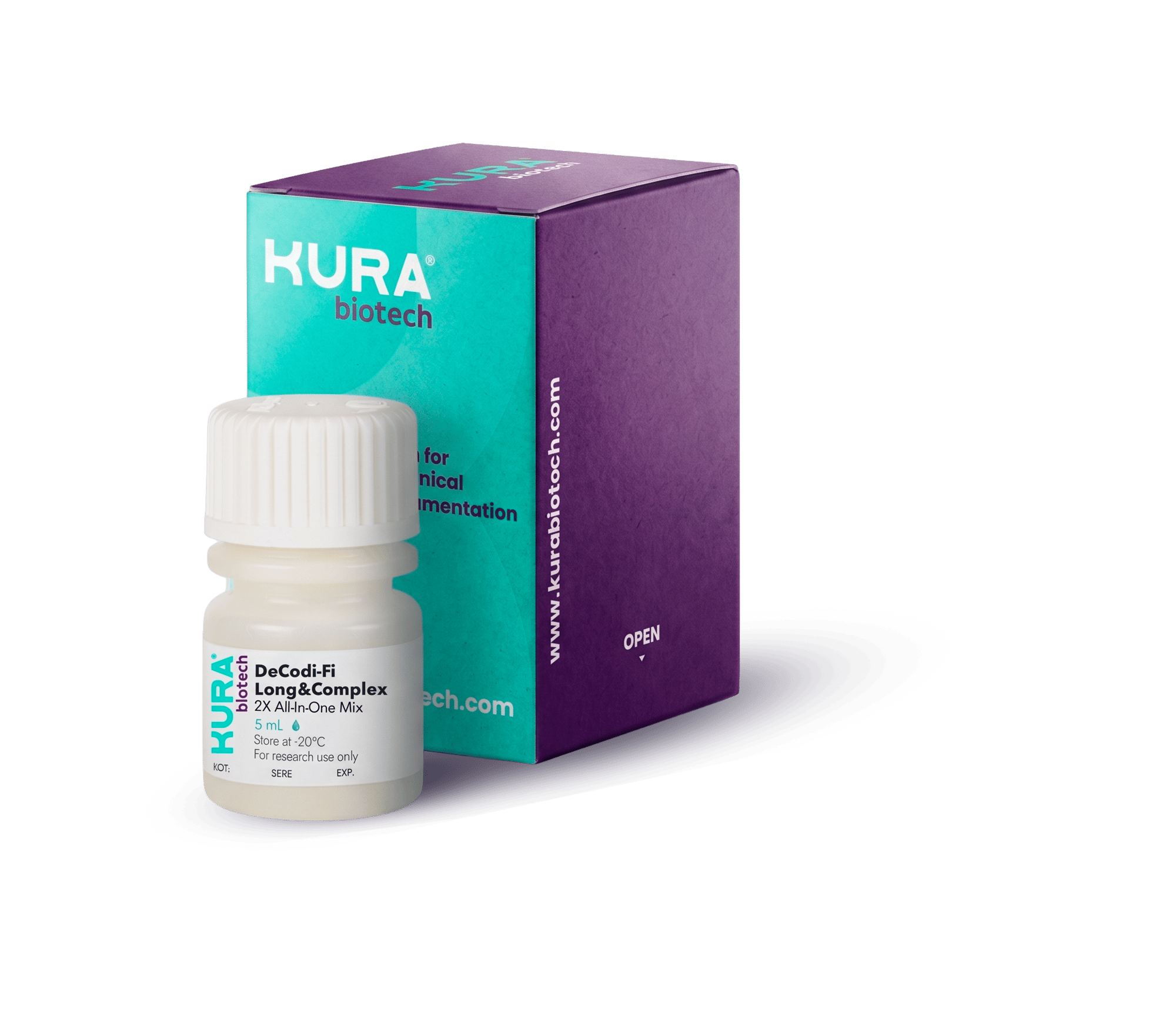
DeCodiFi™ Long&Complex is a hot-start high-fidelity polymerase mix for long-read sequencing library amplification and challenging DNA targets, including long fragments, GC-rich regions, repetitive sequences, expansion repeats, and low-input DNA samples.

Long-read sequencing library amplification

Up to 30 kb from human genomic DNA

Long/GC-rich targets up to 20 kb with 70% GC

Up to 90% GC content

Expansion repeat compatibility

Low-input amplification

Format: 2X All-In-One Mix
Genomics_products_mockup_DEcodifi_LC

Product Overview
Amplify what others can’t.

Some DNA targets fail not because the workflow is wrong, but because the template demands more from the polymerase. Long fragments, high-GC regions, repetitive sequences, and limited input can all make amplification less reliable.

DeCodiFi™ Long&Complex is built for those demanding targets, combining long-range amplification, GC tolerance, fast cycling, and complex-template performance in a 2X All-In-One Mix format.

For long-read sequencing

Optimized for superior library preparation and downstream assembly.
dna

Maximized read lengths

High processivity preserves larger fragments, directly impacting mean read length distributions.

droplet

Improved assembly & N50

Enhances contiguity and N50 metrics by ensuring comprehensive genomic representation.

crosshair

Unbiased coverage

Minimizes library compression and GC-representation bias across diverse genomes.

chart-column

Ultra-low input support

High-efficiency amplification from as little as 100 pg of input DNA, preserving low-yield samples.

For challenging & long-range PCR

Engineered to overcome secondary structures and size limitations.
dna

Extreme GC tolerance

Efficiently amplifies targets with up to 90% GC content, including complex expansion repeats.

droplet

Ultra-long amplification

Robust long-range PCR of fragments up to 30 kb from human genomic DNA.

crosshair

High-complexity accuracy

Clean amplification of complex templates with minimal background.

chart-column

Fast protocols

Extension speeds under 15 sec/kb to accelerate your workflow.

Choose your format

Available in convenient MasterMix or flexible PCR Kit formats.

STREAMLINED SETUP

DeCodiFi™
2X All-In-One Mix

Best for: simple setup, routine workflows, fewer pipetting steps, and higher-throughput use.

A user-friendly 2X MasterMix format containing DeCodiFi™ Hot-Start High-Fidelity Polymerase, dNTPs, MgCl₂, stabilizers, and proprietary buffer. Primers and template are added separately.
  • Product Type: All-In-One / MasterMix

  • Polymerase: DeCodiFi™ Hot-Start High-Fidelity Polymerase

  • Format: 5 mL

  • Reactions: 400

  • Storage: -20°C

FLEXIBLE OPTIMIZATION

DeCodiFi™
High-Fidelity PCR Kit

Best for: flexible optimization, GC-rich templates, and workflows where buffer choice matters.

A flexible PCR kit format with reaction components supplied separately, including a 5X High-Fidelity Buffer for balanced GC/AT templates and a 5X GC-rich Buffer for GC-rich targets.

  • Product Type: PCR Kit

  • Polymerase: DeCodiFi™ Hot-Start High-Fidelity Polymerase

  • Reactions: 400

  • Storage: -20°C

Product format

     OPTIMIZED FOR COMPLEX TEMPLATES  

DeCodiFi™ Long&Complex

2X All-In-One Mix
MasterMix containing polymerase, dNTPs, MgCl₂, stabilizers, and proprietary buffer for long, GC-rich, repetitive, and low-input DNA targets.

Product type: All-in-One/MasterMix

Polymerase: DeCodiFi™ Hot-Start High-Fidelity Polymerase

Format: 5 mL

Reactions: 400

Storage: -20°C

PERFORMANCE DATA

Challenging amplification

Review experimental data showing how DeCodiFi™ Long&Complex performs across high-GC targets, long fragments, low-input samples.


Extreme GC capability

DeCodiFi™ Long&Complex amplifies a 10 kb human IGF2R target containing a 90% GC-rich region, showing amplification across tested annealing temperatures under optimized PCR conditions.
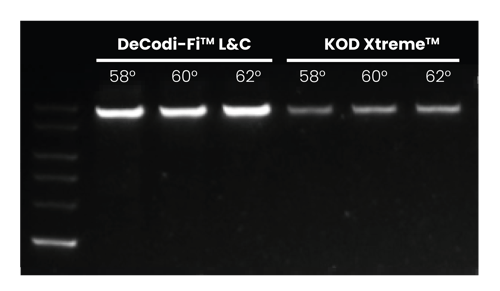
Amplification of the 10 kb human IGF2R gene using DeCodiFi™ Long&Complex and KOD Xtreme™, from 10 ng input DNA, tested at 58°C, 60°C, and 62°C annealing temperatures with 28 PCR cycles.

Amplification of the 10 kb human IGF2R gene using DeCodiFi™ Long&Complex and KOD Xtreme™, from 10 ng input DNA, tested at 58°C, 60°C, and 62°C annealing temperatures with 28 PCR cycles.

Long-range amplification

DeCodiFi™ Long&Complex supports long-range PCR amplification of 30 kb human DNA targets with clean profiles and minimal background.
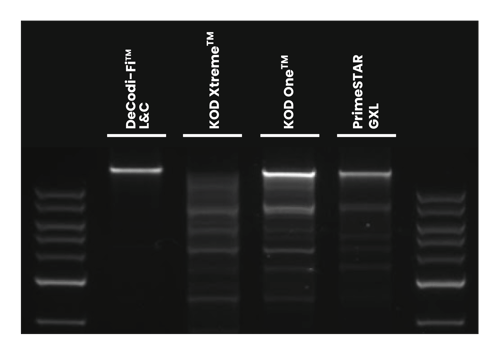
Amplification of 30 kb human DNA using DeCodiFi™ Long&Complex, KOD Xtreme™, KOD One™, and PrimeSTAR GXL, from 10 ng input and 30 PCR cycles.

Amplification of 30 kb human DNA using DeCodiFi™ Long&Complex, KOD Xtreme™, KOD One™, and PrimeSTAR GXL, from 10 ng input and 30 PCR cycles.

High-complexity accuracy

DeCodiFi™ Long&Complex supports clean amplification of 20 kb high-GC genomic fragments.
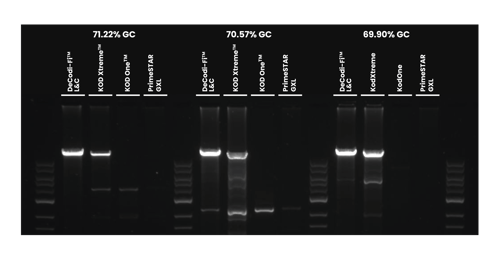
Amplification of 20 kb Streptomyces leeuwenhoekii genomic DNA using DeCodiFi™ Long&Complex, KOD Xtreme™, KOD One™, and PrimeSTAR GXL, from 4 ng input and 27 PCR cycles.

Amplification of 20 kb Streptomyces leeuwenhoekii genomic DNA using DeCodiFi™ Long&Complex, KOD Xtreme™, KOD One™, and PrimeSTAR GXL, from 4 ng input and 27 PCR cycles.

Low-input amplification

DeCodiFi™ Long&Complex supports low-input DNA amplification of long targets, including 17.6 kb beta globin amplification tested across decreasing input amounts.
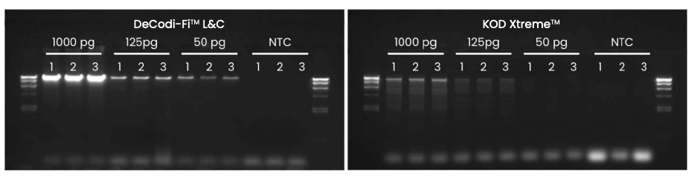
Amplification of the 17.6 kb human beta globin gene was performed using DeCodiFi™ Long&Complex High-Fidelity Polymerase and KOD Xtreme™ Hot Start DNA Polymerase. Each target was amplified from different inputs in a 25 µL reaction: 1000 pg, 125 pg, and 50 pg. A no-template control (0 pg) was also included. All reactions were performed following the optimized conditions for each enzyme and using 30 cycles. The experiment was run in triplicate.

Amplification of the 17.6 kb human beta globin gene was performed using DeCodiFi™ Long&Complex High-Fidelity Polymerase and KOD Xtreme™ Hot Start DNA Polymerase. Each target was amplified from different inputs in a 25 µL reaction: 1000 pg, 125 pg, and 50 pg. A no-template control (0 pg) was also included. All reactions were performed following the optimized conditions for each enzyme and using 30 cycles. The experiment was run in triplicate.

PERFORMANCE DATA

Long read sequencing

Review experimental data showing how DeCodiFi™ Long&Complex performs across low-input long-read library amplification workflows.


Superior library preparation for ultra-low input

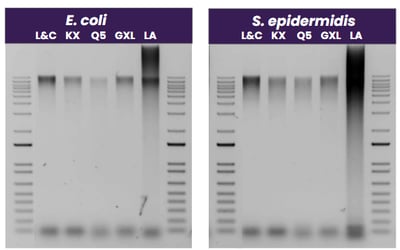
DeCodiFi™ Long&Complex establishes a superior library baseline from ultra low input (1 ng) by shifting fragment distribution toward higher molecular weights. Unlike other polymerases that produce standard smears or non-specific artifacts, Long&Complex delivers the highest concentration of clean, viable libraries required for high-fidelity genomic reconstruction.
Library amplification QC. Comparison of E. coli and S. epidermidis library yields using five polymerases: DeCodi-Fi™  Long&Complex (L&C), KOD Xtreme™ Hot Start DNA Polymerase (KX), Q5® Hot Start High-Fidelity DNA Polymerase (Q5), PrimeSTAR® GXL DNA Polymerase (GXL), and LongAmp®

Figure 1: Library amplification QC. Comparison of E. coli and S. epidermidis library yields using five polymerases: DeCodiFi™  Long&Complex (L&C), KOD Xtreme™ Hot Start DNA Polymerase (KX), Q5® Hot Start High-Fidelity DNA Polymerase (Q5), PrimeSTAR® GXL DNA Polymerase (GXL), and LongAmp® Taq DNA Polymerase (LA). Libraries were generated using the PacBio’s Ampli-Fi protocol with 1 ng of DNA input per 50 µL reaction and a standardized 14-cycle amplification program. Samples were analyzed via agarose gel electrophoresis to characterize size distribution and yield prior to PacBio sequencing.

Longer mean lengths: PacBio® Ampli-Fi protocol

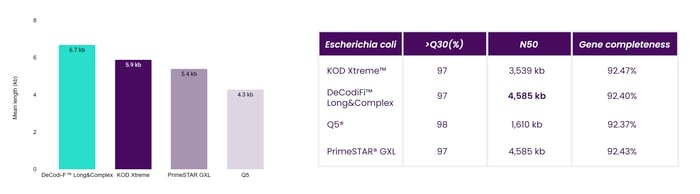
DeCodiFi™ Long&Complex facilitates chromosome-level reconstruction in the PacBio® Ampli-Fi™ protocol by delivering the long HiFi reads necessary to resolve complex architectures. By maintaining high processivity without fragment length compression, it maximizes assembly contiguity in ultra-low input workflows.
E. coli sequencing libraries generated via the PacBio® Ampli-Fi™ protocol. Libraries were amplified using DeCodiFi™ Long&Complex and industry-standard polymerases from a 1 ng DNA input in 50 µL reactions over 14 cycles. Gene completeness was assessed using BUSCO with the enterobacterales_odb12 dataset for E. coli. To ensure compatibility, E. coli samples were normalized to a uniform depth of 63X, corresponding to the lowest coverage sample for the genome.

E. coli sequencing libraries generated via the PacBio® Ampli-Fi™ protocol. Libraries were amplified using DeCodiFi™ Long&Complex and industry-standard polymerases from a 1 ng DNA input in 50 µL reactions over 14 cycles. Gene completeness was assessed using BUSCO with the enterobacterales_odb12 dataset for E. coli. To ensure compatibility, E. coli samples were normalized to a uniform depth of 63X, corresponding to the lowest coverage sample for the genome.

Higher assembly contiguity: Oxford Nanopore™

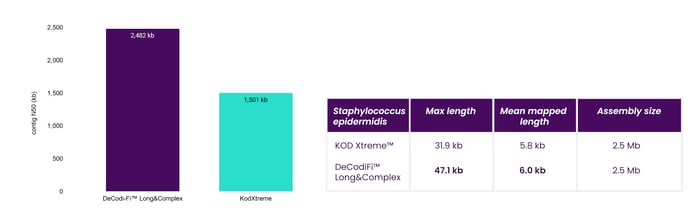
DeCodiFi™ Long&Complex optimizes Oxford Nanopore™ assembly by capturing ultra-long fragments up to 47.1 kb. By maximizing fragment reach, it delivers a 65% increase in Contig N50, enabling researchers to achieve superior assembly contiguity and efficiency in complex genomic architectures through optimized coverage and reduced sequencing costs.
Recurso 5@30x-100

Working with ultra-low input long-read libraries?

Polymerase choice can influence read length, coverage representation, and assembly contiguity. Talk to our team about evaluating DeCodiFi™ Long&Complex in your long-read sequencing workflow.

DeCodiFi™ Long&Complex is a PacBio-recommended polymerase in the Ampli-Fi HiFi protocol

Independently evaluated by PacBio's AppsLab on the HG002 human reference genome, DeCodiFi™ Long&Complex delivers strong performance in read length (10.15 kb mean) and assembly contiguity, and joins PacBio's updated Ampli-Fi protocol as a tested and recommended polymerase for HiFi library preparation.  As a direct manufacturer with stable supply chains and consistent QC, Kura Biotech® offers PacBio users a validated option with continuity of supply and regional technical support. DeCodiFi™ Long&Complex is also designed to be cost-competitive within the validated options for the protocol.

Talk to our team to access the evaluation summary, optimized protocol conditions, and integration support for your HiFi workflows


APPLICATIONS

Sequencing & Library Preparation

DeCodiFi™ Long&Complex supports sequencing workflows where amplification quality can affect fragment recovery, read-length distribution, GC representation, and downstream assembly.

dna-dark

Long-read sequencing

For ultra-low input workflows where polymerase processivity, longer read distributions, and reduced library compression are important.

layers-white

Whole-genome assembly

For workflows where read length, coverage representation, and assembly contiguity can influence downstream genome reconstruction.

database-light

NGS library amplification

For sequencing library preparation workflows involving GC-rich, repetitive, or low-input DNA targets.

APPLICATIONS

DNA Amplification and High-Fidelity PCR

DeCodiFi™ Long&Complex supports high-fidelity amplification of challenging DNA targets that require more than standard PCR conditions.

expand-dark

Difficult-template amplification

For long, GC-rich, repetitive, or structured DNA targets that are difficult to amplify with standard polymerases.

list-check-white

High-Fidelity PCR

For amplification workflows where accuracy, yield, and target complexity are important.

dna-white

Genotyping

For workflows involving challenging genomic regions, including repetitive DNA regions.

 

RESOURCES

Technical Documentation

Technical Data Sheet / Protocol

DeCodiFi™ Long&Complex TDS / Protocol

VIEW 


Brochure

DeCodiFi™ Long&Complex brochure

VIEW

Posters

Enzymatic Determinants of Read Length in Ultra-Low Input HiFi Assembly: A Systematic Polymerase Evaluation under the Ampli-Fi Workflow

VIEW

Testimonials

DeCodi-Fi™ generates more homogeneous products, requires less template to amplify, and also needs shorter extension times in each amplification cycle. Therefore, it is more efficient and has proofreading activity that enables the generation of more homogeneous products.
DeCodiFi™ generates more homogeneous products, requires less template to amplify, and also needs shorter extension times in each amplification cycle. Therefore, it is more efficient and has proofreading activity that enables the generation of more homogeneous products.

Carlos Loncoman, Ph.D.

Assistant Professor, Universidad Austral de Chile
I just tested DeCodiFi™ and compared it to the one I regularly use in the lab for cloning. The yield (amount of product) is higher, and without a doubt, I can say that I like the product because it is so simple and fast to work with, while also giving me confidence that it is a high-fidelity enzyme. The kit is very easy to use since everything comes ready to go, which is really convenient.

Cristian Droppelmann, Ph.D.

Research Associate/Team Leader, The University of Western Ontario
I want to highlight the speed of the PCR—it shortens the reaction time by about 20–30 minutes. The PCR product yield is great, making it easy to identify the desired fragment. I'm very satisfied with DeCodi-Fi™. One of the diseases I study involves a candidate gene with high GC content and pseudogenes, which makes PCR quite challenging. I work with limited amounts of DNA and still achieve high yields of the desired product. When dealing with patient samples, where material is low, that's a major advantage.
I want to highlight the speed of the PCR—it shortens the reaction time by about 20–30 minutes. The PCR product yield is great, making it easy to identify the desired fragment. I'm very satisfied with DeCodiFi™. One of the diseases I study involves a candidate gene with high GC content and pseudogenes, which makes PCR quite challenging. I work with limited amounts of DNA and still achieve high yields of the desired product. When dealing with patient samples, where material is low, that's a major advantage.

Paola Krall, Ph.D.

Academic, Universidad de Chile
Kura Biotech's enzyme is of excellent quality and surpasses many of the options currently available on the market. The objective of the experiment was to generate a plasmid encoding a truncated protein using the overlap PCR technique. The results with DeCodi-Fi™ were very positive: we managed to correctly generate the desired plasmid, and the PCRs were fast and consistent. No errors or aberrant products were observed at any point in the process.
Kura Biotech's enzyme is of excellent quality and surpasses many of the options currently available on the market. The objective of the experiment was to generate a plasmid encoding a truncated protein using the overlap PCR technique. The results with DeCodiFi™ were very positive: we managed to correctly generate the desired plasmid, and the PCRs were fast and consistent. No errors or aberrant products were observed at any point in the process.

Ignacio Valencia

Researcher, Platech Company

SUPPORT

Frequently Asked Questions


When should I choose DeCodiFi™ Long&Complex instead of DeCodiFi™ High-Fidelity Polymerase?

Choose DeCodiFi™ Long&Complex when your workflow involves challenging DNA targets, such as long fragments, high-GC regions, repetitive sequences, expansion repeats, or limited input DNA. For broader high-fidelity PCR and sequencing workflows, DeCodiFi™ High-Fidelity Polymerase may be the better starting point.


What types of targets is DeCodiFi™ Long&Complex optimized for?

DeCodiFi™ Long&Complex is optimized for challenging templates, including long DNA fragments up to 30 kb, high-GC regions up to 90% GC, low DNA inputs, and templates containing expansion repeats.


What applications is DeCodiFi™ Long&Complex recommended for?

DeCodiFi™ Long&Complex is recommended for PCR amplification of high-GC or complex DNA regions, including regulatory elements and repetitive sequences. It is also designed to support library amplification for long-read sequencing workflows involving low-input samples, high-GC genomes, or long targets that require high fidelity and robust performance.

What is included in the 2X All-In-One Mix?

The 2X All-In-One Mix contains DeCodiFi™ Hot-Start High-Fidelity Polymerase, dNTPs, MgCl₂, stabilizers, and GC enhancers in a proprietary buffer optimized for higher coverage. Primers and template DNA are not included.

Do primers require special design?

Yes. Due to the strong 3′-exonuclease proofreading activity of DeCodiFi™ Long&Complex, we recommend incorporating two phosphorothioate bonds at the 3′ ends of primers. This modification prevents primer degradation, improves specificity, and minimizes primer dimer formation.

How should I set up the PCR reaction?

Always set up reactions on ice to protect primers from exonuclease activity. Mix components in a sterile tube or plate, centrifuge briefly, and transfer immediately to the thermal cycler. For optimal results, we strongly recommend a temperature gradient (starting 4°C below the lowest calculated Tm​) to identify the ideal annealing stringency.

What input amount is recommended?

Template input should be calibrated based on genomic complexity. Aim for at least 104 copies per reaction. As a baseline for a 25 µL reaction:

  • Prokaryotic genomes: 5–10 ng (e.g., >0.05 ng for E. coli).
  • Eukaryotic genomes: 10–50 ng (e.g., >34 ng for Human gDNA).
  • Plasmids or Phages: ≤1 ng.

What extension time and temperature should I use with DeCodiFi™ Long&Complex?

Use a rate of 30 seconds per kilobase. The optimal temperature depends on your goal:

  • 68°C: Recommended for library amplification or when maximizing yield is the priority.
  • 72°C: Recommended for amplicon PCR to ensure higher specificity.

Note: For repetitive fragments or non-specific products, a step-down program is also advised.

How many cycles are necessary?

Standard protocols use 10–30 cycles. We recommend using the minimum number of cycles required for your specific input; lower cycling reduces the probability of stochastic errors, non-specific products, and smearing.


Should I run a temperature gradient?

Yes, a gradient PCR is strongly recommended when setting up cycling conditions. Use the lower primer Tm as a reference, starting 4°C below that value and increasing in 2°C increments up to 4°C above the calculated Tm.

What should I do for expanded repeats or nonspecific amplification in long amplicons?

For expanded repeats or nonspecific amplification in long amplicons, use the stepdown PCR program provided in the protocol. For expanded repeats with 100% GC-rich content, contact technical support for guidance on the most appropriate solution for your application.

How should DeCodiFi™ Long&Complex be stored and shipped?

Store DeCodiFi™ Long&Complex at -20°C upon arrival and avoid repeated freeze-thaw cycles. The mix is designed to be transported at 2–8°C without loss of performance for up to 7 days, helping reduce dry ice use and simplify logistics.

Can I get technical support for optimizing a difficult target?

Yes. If you are working with long fragments, high-GC targets, repetitive regions, expansion repeats, or low-input samples, our team can help evaluate template input, primer design, cycling conditions, gradient setup, and whether a stepdown PCR strategy is appropriate.

Why does polymerase choice matter in long-read sequencing library amplification?

In amplification-based long read sequencing workflows, the polymerase can influence read-length distribution, GC representation, and library compression. These factors can affect downstream assembly contiguity, especially when starting from ultra-low DNA input.

CONTACT US

Ready to evaluate DeCodiFi™ Long&Complex?

Request product information or connect with our team to discuss your challenging DNA amplification workflow.


Related products


DeCodiFi™ High-Fidelity Polymerase

For general high-fidelity PCR and sequencing workflows.

Learn more

DeCodiFi™ Alpha

For ultra-high fidelity NGS library amplification, uniform coverage, and low-input short-read sequencing workflows.

Learn more

DeCodiFi™ Plant Direct

For direct amplification from plant samples.


Learn more

DeCodiFi™ Blood Direct

For direct amplification from blood samples.


Learn more