A hot-start high-fidelity DNA polymerase designed to amplify long DNA fragments up to 44 kb, with high yield, fast cycling, and low bias from low-input samples.
Up to 44 kb amplification
64% lower error vs. KAPA™ HiFi
Fast cycling: under 15 sec/kb
Low-input compatibility
25%–85% GC compatibility
Uracil tolerance
Formats: 2X All-In-One Mix
High-Fidelity PCR Kit
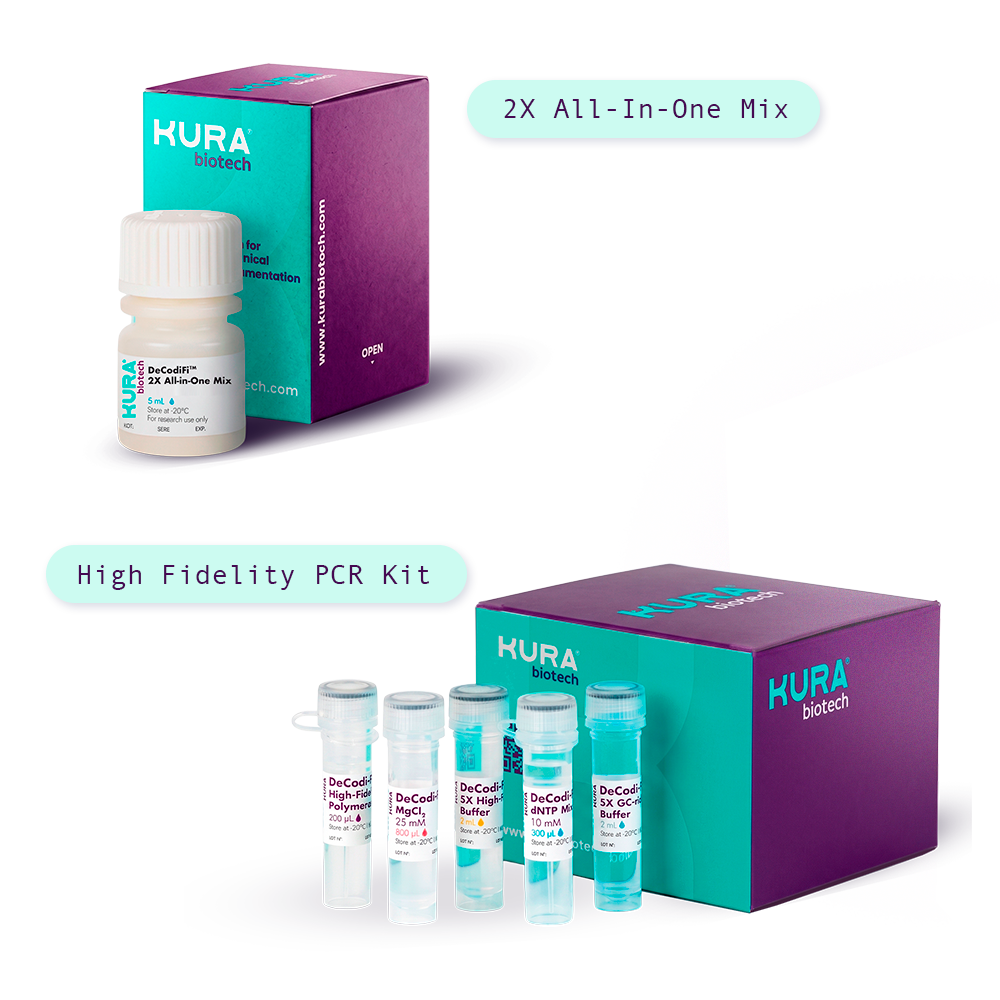
DeCodiFi™ is a hot-start high-fidelity DNA polymerase designed to support demanding PCR and sequencing library preparation workflows. It combines long-target amplification up to 44 kb with high yield, low-bias coverage, low-input compatibility, and uracil tolerance.
Amplifies up to 44 kb, delivering high-yield templates ready for long-read sequencing platforms.
Amplifies complex DNA from as little as 0.1 ng and medium-complexity templates from 5 pg.
More than 60% reduction in error rates, delivering high-accuracy amplification for precision-critical applications.
Uniform amplification and high DNA recovery, even from challenging or GC-rich templates (25%–85% GC).
Achieves rapid amplification with extension speeds under 15 sec/kb.
Efficiently reads through uracil, supporting both methylation analysis and protocols involving damaged DNA.
STREAMLINED SETUP
Product Type: All-In-One / MasterMix
Polymerase: DeCodiFi™ Hot-Start High-Fidelity Polymerase
Format: 5 mL
Reactions: 400
Storage: -20°C
FLEXIBLE OPTIMIZATION
Product Type: PCR Kit
Polymerase: DeCodiFi™ Hot-Start High-Fidelity Polymerase
Reactions: 400
Storage: -20°C
DeCodiFi™ is also available in a non-hot-start version, made on request and customizable to your workflow needs.
PERFORMANCE DATA
Maximize target yield with highly efficient amplification, even with fragment sizes up to 44 kb.
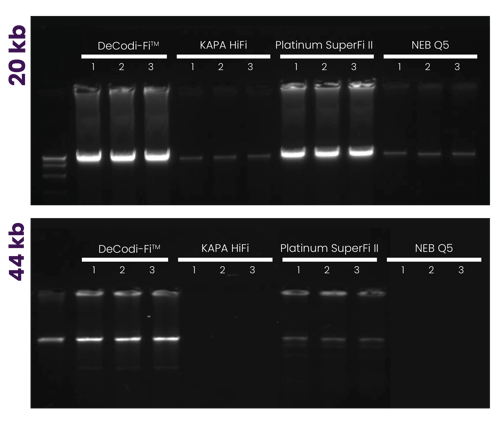
Amplification of lambda DNA fragments 20 kb and 44 kb with DeCodiFi™ High-Fidelity polymerase, KAPA HiFi, Platinum SuperFi II, and Q5. Each target was amplified from low input (1ng). Reactions were performed following the optimized conditions for each enzyme and using 24 cycles. The experiment was run in triplicate.
DeCodiFi™ supports amplification of long DNA targets from limited template input, including 17.6 kb beta globin amplification tested across decreasing DNA input amounts.
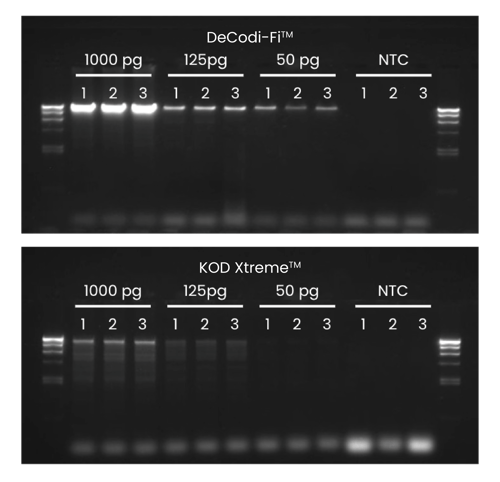
Amplification of the 17.6 kb human beta globin gene was performed using DeCodiFi™ High-Fidelity Polymerase and KOD Xtreme™ Hot Start DNA Polymerase. Each target was amplified from different inputs in a 25 μL reaction: 1000 pg, 125 pg, and 50 pg. A no-template control (0 pg) was also included. All reactions were performed following the optimized conditions for each enzyme and using 30 cycles. The experiment was run in triplicate.
DeCodiFi™ showed a 64% reduction in error rates compared to KAPA™ HiFi in an Illumina library-based fidelity comparison.
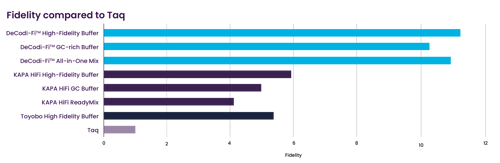
Comparison of DeCodiFi™, KAPA HiFi, and Toyobo HiFi, measured in terms of fold improvement over Taq Polymerase, based on Illumina libraries of the complete E. coli genome.
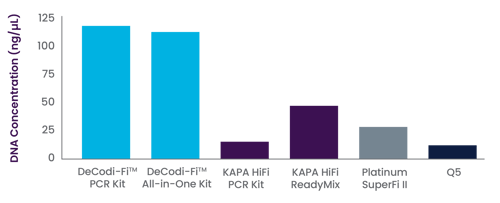
DNA concentration obtained from 25 μL of lambda 15 kb PCR reaction using DeCodiFi™ PCR kit, DeCodiFi™ All-in-One Mix, and competitors' enzymes (Kapa HiFi, Platinum SuperFi II, and Q5). The experiment was run in triplicate.
DeCodiFi™ supports low-bias amplification across tested common, AT-rich, and GC-rich genomes, helping preserve more uniform sequence coverage in sequencing library workflows.
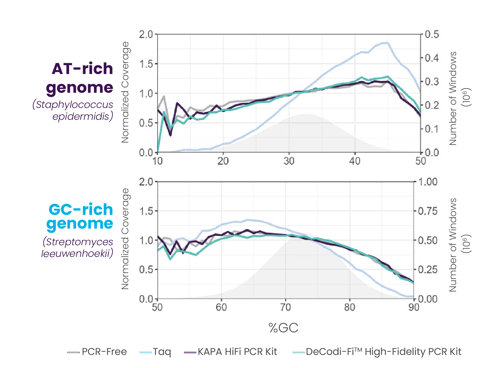
Illumina libraries prepared from a common genome (Escherichia coli) were amplified using Taq polymerase, KAPA HiFi PCR kit, and DeCodiFi™ High-Fidelity PCR kit (left). Illumina libraries prepared from an AT-rich genome (Staphylococcus epidermidis) and a GC-rich genome (Streptomyces leeuwenhoekii) were amplified using Taq polymerase, KAPA HiFi PCR kit, and DeCodiFi™ High-Fidelity PCR kit (right).
APPLICATIONS
For workflows where longer DNA fragments and low-input amplification are important.
For targeted sequencing workflows that require accurate and consistent amplification.
For workflows where amplification quality and sequence representation can influence downstream genome analysis.
APPLICATIONS
For routine and demanding amplification workflows where accuracy and yield matter.
For long, complex, or high GC templates where high-fidelity amplification, yield, and cycling efficiency are important.

RESOURCES
Unveiling Microbial Diversity Cost-Effective 16S rRNA Amplicon Sequencing using DeCodiFi™ High Fidelity Polymerase
VIEW
DeCodiFi™: A Cost-Effective Polymerase for High-Quality Genome Assembly of Marine Sediment Bacteria
VIEW
Solving amplification of high-GC expanded repeats to enable rare disease detection using long-read sequencing
VIEW
A long-read 16S rRNA sequencing workflow enhances bacterial diversity recovery from rhizospheric soils of a salt flat in the Atacama desert
VIEW
Resistance of High-Fidelity DNA polymerases to magnetic beads' presence
VIEW
Direct PCR from Crude Plant Extracts Using DeCodiFi™ High-Fidelity Polymerase
VIEW
DeCodiFi™ in Amplicon Sequencing: A Sensitive High-Fidelity Polymerase for Xanthomonas citri Pathovar Differentiation
VIEW
Oxford Nanopore 16S Sequencing of Soil Samples from the Atacama Desert
VIEW
Comparative analysis of size bias in PCR Multiplex amplification using DeCodiFi™ vs commercial HiFi polymerases
VIEW
Clinical Chemistry - B-224 Long read sequencing: High-fidelity amplification of disease-associated complex genomic regions using DeCodiFi™ polymerase
VIEW
Carlos Loncoman, Ph.D.
Assistant Professor, Universidad Austral de Chile
Cristian Droppelmann, Ph.D.
Research Associate/Team Leader, The University of Western Ontario
Paola Krall, Ph.D.
Academic, Universidad de Chile
Ignacio Valencia
Researcher, Platech Company
SUPPORT
Choose DeCodiFi™ when your workflow requires high-fidelity and/or long amplification with strong yield, low-bias coverage, fast cycling, low-input compatibility, and flexible format options for PCR or sequencing library preparation workflows.
Choose DeCodiFi™ 2X All-In-One Mix for simple setup, fewer pipetting steps, routine workflows, and higher-throughput use.
Choose DeCodiFi™ High-Fidelity PCR Kit when you need more optimization flexibility. Use the High-Fidelity Buffer when maximum fidelity is the priority or when working with balanced GC/AT templates. Use the GC-rich Buffer when amplifying high-GC amplicons, up to 80% GC.
A Non-Hot-Start version is also available on request for custom workflow needs.
For DNA fragments under 1 kb, DeCodiFi™ typically requires 30 seconds of extension. For larger fragments, add 15 seconds per additional kilobase. For example, a 23 kb fragment would require approximately 6 minutes of extension.
DeCodiFi™ supports amplification from low input amounts, including high-complexity DNA from 0.1 ng and medium-complexity templates from 5 pg. As a general starting point, use 5–50 ng for genomic DNA and less than 1 ng for templates smaller than 50 kb. Exact input should be optimized based on template complexity, target size, and application.
We recommend starting with 25 cycles for most PCR workflows when input is above 10⁴ template copies. Keep cycling under 30 cycles, especially for amplicons larger than 10 kb. For Illumina sequencing libraries below 600 bp, 12–14 cycles can be used as a starting point when beginning from 1 ng of template.
DeCodiFi™ HotStart High-Fidelity Polymerase is inactivated by an antibody until the initial thermal denaturation step. This helps prevent non-specific priming during reaction setup and improves amplification specificity.
Yes. DeCodiFi™ is designed to read through and amplify uracil-containing DNA, supporting workflows such as methylation analysis, damaged DNA amplification, and protocols involving uracil-containing primers or templates.
Because DeCodiFi™ has strong proofreading activity, we recommend adding two phosphorothioate bonds at the 3′ end of primers to help prevent 3′ exonuclease degradation. This is especially important for shorter primers and NGS library amplification workflows. Refer to the protocol for examples and ordering notation.
Yes. A Non-Hot-Start version of DeCodiFi™ is available on request and can be customized to specific workflow needs.
Yes. Custom and OEM solutions are available for teams that need enzyme optimization, buffer refinement, custom formulations, or manufacturing support.
Store DeCodiFi™ at -20°C immediately upon receipt and avoid repeated freeze-thaw cycles. DeCodiFi™ is designed to be transported at 2°C to 8°C without performance loss, with stability confirmed under those conditions for at least 10 days during transport.
For ultra-high fidelity NGS library amplification, uniform coverage, and low-input short-read sequencing workflows.