ENGINEERED TdT VARIANT
TdT for natural nucleotides is an engineered terminal deoxynucleotidyl transferase designed to efficiently incorporate natural or modified deoxynucleotides (ddNTPs) to the 3' end of DNA strands.
Built for researchers developing high-efficiency extension, homopolymer tailing, 3’ end labeling, this TdT gives teams a high-performance option for synthesis using natural and common modified nucleotides (e.g., ddNTP).
Natural nucleotide and modified nucleotides (ddNTP) incorporation
DNA end extension workflows
DNA homopolymer tailing
DNA end-labeling (ddNTP)
TdT for natural nucleotides gives researchers access to one of Kura Biotech’s engineered TdT variants in a standalone format. It is designed for teams working with natural or modified nucleotides who need a focused enzyme option for method development, optimization, or continued use after panel screening.
TdT for natural nucleotides is best positioned for applications where natural nucleotide compatibility is the main requirement.
Specifically designed for consistent performance in homopolymer tailing, 3’ end labeling with modified nucleotides, and supporting established methods like TUNEL assays and TdT-dependent PCR.
Discuss your nucleotide, substrate, reaction conditions, and application goals with our team.
Product Type: All-In-One / MasterMix
Polymerase: DeCodiFi™ Alpha Hotstart High-Fidelity Polymerase
Format: 5 mL
Reactions: 400
Storage: -20°C
Standalone engineered TdT variant
Best for:
Teams working with natural or modified nucleotide (ddNTPs) incorporation.
Six engineered TdT variants for workflow screening
Best for:
Teams that are still comparing enzyme behavior across nucleotide types, substrate structures, or application conditions
If you are comparing nucleotide types, working across multiple substrates, or unsure whether TdT for natural nucleotides is the right starting point, begin with the TdT Synthesis Panel to evaluate multiple engineered variants before choosing a standalone enzyme.
PERFORMANCE DATA
DeCodiFi™ Alpha shows an ultra-high fidelity profile in an Illumina library-based comparison of polymerase error rates, supporting workflows where polymerase-introduced errors can affect downstream interpretation.
HIGHER FIDELITY
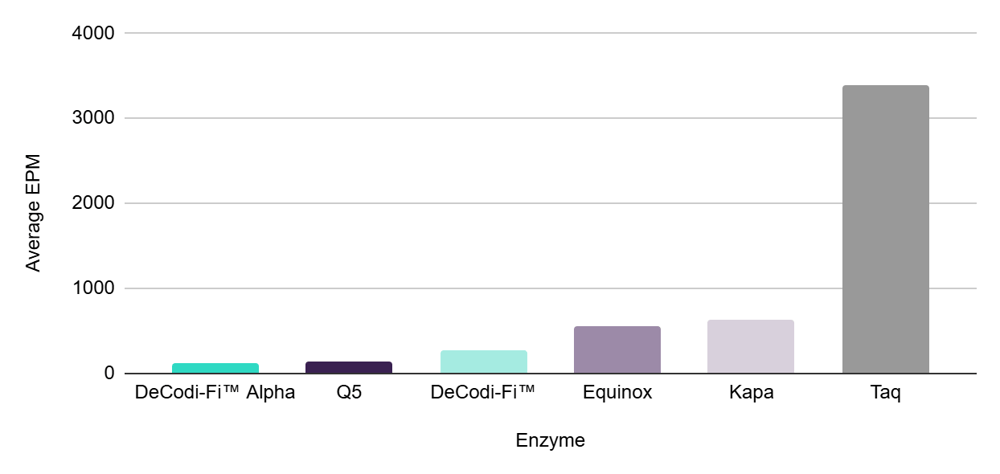
Comparison of DeCodiFi™ Alpha 2X All-In-One Mix, Kura DeCodiFi™ 2X All-In-One Mix, Q5® High-Fidelity 2X Master Mix, Watchmaker Equinox Library Amplification Kit, Roche KAPA HiFi HotStart ReadyMix, and Taq, measured in error per million based on Illumina libraries of the complete E. coli genome.
DeCodiFi™ Alpha supports uniform coverage across tested genomic regions, helping reduce GC-related coverage bias during NGS library amplification.
UNIFORM COVERAGE
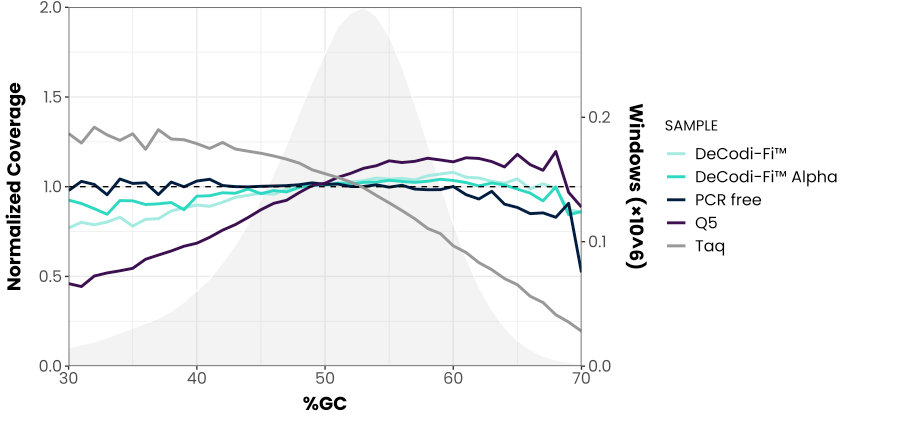
Illumina libraries prepared from an E. coli genome were amplified using DeCodiFi™ Alpha 2X All-In-One Mix, DeCodiFi™ 2X All-In-One Mix, Q5® High-Fidelity 2X Master Mix, and Taq polymerase.
APPLICATIONS
For the efficient addition of poly-nucleotide tails (e.g., Poly-A) to the 3' ends of DNA, essential for cloning and sequencing preparation.
For precise DNA labeling using modified nucleotides such as ddNTPs to create high-quality probes and markers.

Carlos Loncoman, Ph.D.
Assistant Professor, Universidad Austral de Chile
Cristian Droppelmann, Ph.D.
Research Associate/Team Leader, The University of Western Ontario
Paola Krall, Ph.D.
Academic, Universidad de Chile
Ignacio Valencia
Researcher, Platech Company
SUPPORT
TdT for natural nucleotides is best suited for applications involving natural dNTPs and NTPs, especially when the goal is to optimize extension performance, refine reaction conditions, or continue development after identifying a preferred enzyme from our TdT synthesis panel.
.Yes. TdT for natural nucleotides is positioned for workflows based on natural nucleotides, making it a strong option for researchers who are not primarily working with blocked nucleotide chemistries.
Yes. TdT for natural nucleotides is positioned for workflows based on common modified nucleotides such as ddNTPs. If you are working with other chemistries, we recommend starting with the TdT Synthesis Panel or discussing your application with our team.
TdT for natural nucleotides should not be positioned as the lead choice for blocked nucleotide workflows. If your application depends on 3′-amino blocked nucleotides or repeated deblocking cycles, TdT for blocked is the more appropriate product to highlight. If you are working with other chemistries, we recommend starting with the TdT Synthesis Panel or discussing your application with our team.
TdT for natural nucleotides is a good choice when you have already identified it as the right fit for your workflow and want to continue development with a single enzyme. If you are still comparing variants or exploring which TdT best matches your chemistry, the TdT Synthesis Panel is usually the better starting point.
TdT for natural nucleotides can support:
Homopolymer tailing: Adding poly-N tails (A, T, C, G) to the 3’ ends of DNA.
DNA end-labeling: Creating probes and markers using modified nucleotides like ddNTPs or DIG-dUTP.
Apoptosis detection: Serving as the core enzyme for sensitive TUNEL assays.
Template-independent amplification: Facilitating TdT-dependent PCR and RACE protocols.
Standard synthesis development: Building methods that require efficient incorporation of natural dNTPs and NTPs.
Yes. TdT for natural nucleotides is well-suited for method development when your workflow depends on natural nucleotide use, and you want to reduce complexity by working with a single engineered TdT.
Yes. TdT for natural nucleotides is a practical next step for teams that started with the TdT panel and want to move into a standalone format for continued optimization, repeat experiments, or routine use.
TdT for natural nucleotides is best positioned for natural and modified nucleotide workflows, while TdT for blocked nucleotides is better suited for 3′-amino blocked nucleotide incorporation and iterative synthesis workflows. If your work depends on reversible blocking strategies, TdT for blocked nucleotides is likely the stronger fit.
Yes. If you share your workflow, nucleotide type, and development goals, our team can help you determine whether TdT for natural nucleotides, TdT for blocked nucleotides , or the TdT Synthesis Panel is the best fit.
For general high-fidelity PCR and sequencing workflows.