



MAKE CONFIDENT DECISIONS
Detect pathogens, characterize positive findings through genomic analysis, and integrate microbiological results to make more informed decisions across your facility.
Detect pathogens quickly, investigate positive findings, or integrate your results for ongoing monitoring. Our solutions can be used independently or combined to provide a more complete view of microbiological risk across your facility.
Detect faster and simplify your microbiological control.
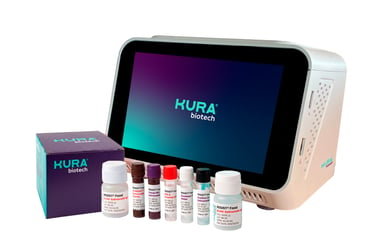
Detect Listeria monocytogenes and Salmonella spp. in food and environmental surfaces with a system designed to reduce complexity and optimize costs.
Investigate recurring findings and potential contamination routes.
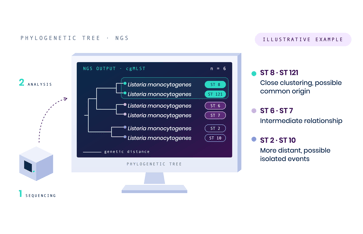
Characterize and compare findings to assess potential relationships between positive results and guide the search for contamination sources.

Integrate your results and identify trends.
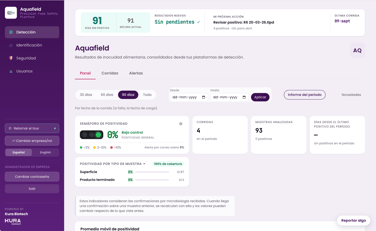
Centralize results from your detection systems. Review historical data, identify trends, and generate reports to support timely action.
When a positive result appears again, you need to know where it was previously detected, what historical information is available, and whether it could be related to other findings.
Here is how our solutions can work together to investigate a finding.
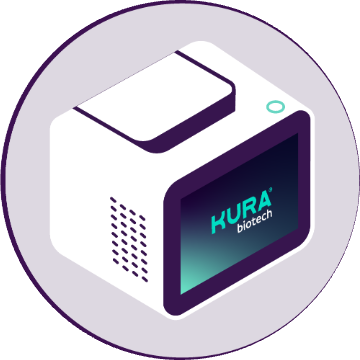
Detect Listeria monocytogenes and Salmonella spp. in food and environmental surfaces through a two-step molecular workflow after enrichment.
Automated readout provides qualitative results to support decision-making in your laboratory and facility.
Review historical data by date and sampling point to identify recurring findings and guide follow-up.
When deeper investigation is needed, characterize and compare isolates to assess potential relationships between findings and guide the investigation.
Integrate results from different systems, review trends, and share information across laboratory, quality, and facility teams.
Bring together historical information, assess potential relationships between findings, and prioritize investigation and follow-up across your facility.
Combine results, historical data, and specialized analysis to guide cleaning and sanitation, prioritize interventions, and verify the effectiveness of actions across your facility.



1
2
Enrichment→
1 Extraction→
2 Amplification and interpretation
Genomic sequencingMore information to guide cleaning, focus your actions, and strengthen food safety.
Start with the current needs of your laboratory or facility and explore which solutions can complement them.
Talk to a specialistThis portfolio combines molecular detection with RESIST® Food, genomic characterization of pathogens, and integration of results with the Precision Food Safety Platform. These solutions help generate timely results, investigate findings, and review historical data to guide decisions and actions on the production floor.

No. You can implement each solution based on the needs of your laboratory or facility: to simplify detection, conduct more in-depth investigations of positive results, or centralize your results. The tools complement one another, and you can expand their use as your food safety program requires.
RESIST® Food detects Listeria monocytogenes and Salmonella spp. in food and on surfaces. It features a two-step molecular workflow following enrichment, with automated reading, to simplify analysis and deliver timely results.
The platform allows users to see where and when positive cases recur. Genomic characterization makes it possible to compare isolates and assess potential relationships among them. This information helps guide research and the follow-up of findings at the facility.
Yes. The Precision Food Safety Platform allows you to consolidate results from RESIST® Food and other detection systems. This enables the laboratory, quality control, and production teams to view a shared history, review trends, and access the information simultaneously from different computers.
Test results, microbiological history, and genomic comparisons provide information to help identify where to focus further investigation. Interpreting this information helps guide recommendations for cleaning and sanitization, prioritize interventions, and establish a follow-up plan to evaluate the actions taken.
Yes. Our team evaluates the characteristics of the matrix and the factors that could interfere with the analysis using RESIST® Food. Depending on the application, it determines the necessary adjustments to reduce interference and optimize the protocol.
The starting point is what you need to accomplish: obtaining screening results, investigating possible connections between positive cases, or gathering scattered information. Our team helps you determine which solution is right for your application and how it can complement your current program.